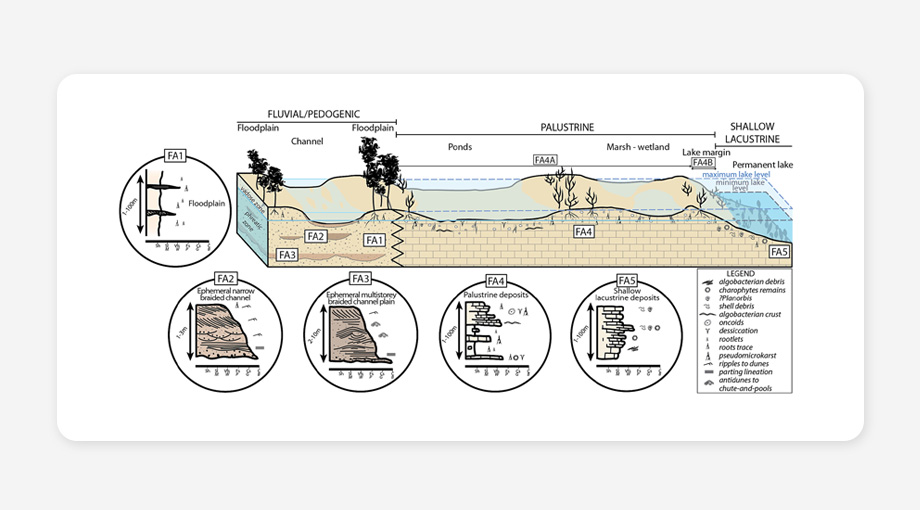
Fig. 7. Profle showing fluvial and palustrine to
shallow-lacustrine depositional environments
(not to scale), and corresponding lithological
sections of the facies associations defned in
Part. 4.1 (modifed from Freytet,
1984 and Alonso-Zarza, 2003).

References

Boyrie, C., Girard, F., BALLAS, G., LIHOREAU, F., BENAMMI, M., BOURGET, H., … & Tabuce, R. (2025). Abrupt changes in continental sedimentation triggered by monsoon-type event during EECO hyperthermals, Minervois Basin, Southern France. Sedimentary Geology, 486, 106923.

DOI: 10.1016/j.sedgeo.2025.106923
hal-05300426

Abrupt changes in continental sedimentation triggered by monsoon-type event during EECO hyperthermals, Minervois Basin, Southern France

Recent studies on Early Eocene climate have established that global climatic warming, characterized by negative carbon isotopic excursions (CIE, hyperthermals) in the atmosphere, are responsible for drastically changes in the terrestrial sedimentary record of sub-tropical basins.

Here we present a key sedimentary record to understand geological and climatological changes in order to evaluate the impact of hyperthermals on sediment transport and deposition in continental setting during the Early Eocene Climatic Optimum (EECO) in Europe. Based on an integrative study combining sedimentology, sequential stratigraphy, magnetostratigraphy and chemostratigraphy (carbon isotopes, δ13Corg), the study proposes a detailed constrained chronostratigraphic framework of continental sedimentary series of the Minervois Basin (South of France). Using facies association analysis, the sedimentary succession is divided into three continental sequences bounded by subaerial unconformity deposited through the development of an endoreic underfilled basin. The sequences are composed of floodplain to palustrine-shallow lacustrine carbonate deposits reflecting arid climatic conditions during the EECO.

They are cyclically punctuated by the sudden arrival of detrital fluxes with deposits of supercritical bedforms associated to an ephemeral multistorey braided channel plain, reflecting intense and extreme rainfall events in the hinterland. The latter coincides to CIEs corresponding to hyperthermals identified as C24n.1nH1/K (ETM3), C23rH2 (M), and C23n.2nH1-C23n.2nH2 (Nsingle bondO) interval.

Extreme monsoon-type events triggered by intense warm-ups during hyperthermals are proposed to explain sudden detrital inputs in the basin. This work confirms that transient hyperthermals can generate drastic hydrological changes in the sedimentary record.

March 8-10 2027

7th Virtual Conference for Women Archaeologists and Paleontologists

Scroll to Top