



Missions
Greece

General research question
The excavations at Dafnero aim to describe the faunas and environments of the Balkans during the Early Pleistocene, a key age and region in the evolution of the genus Homo during the first dispersal out of Africa.
Selected results
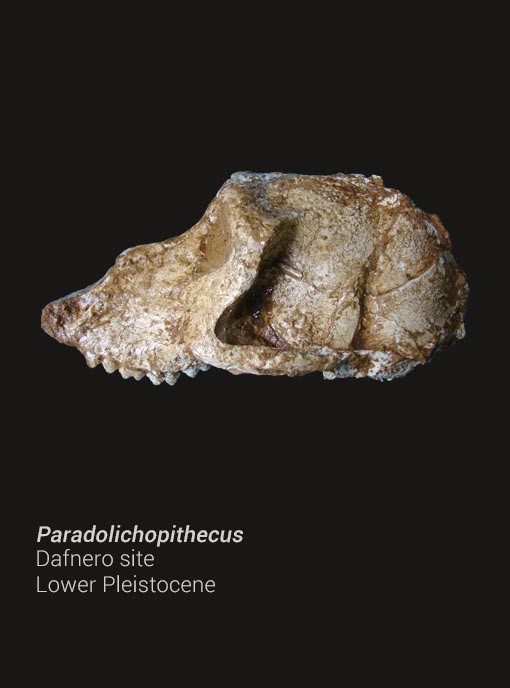
These excavations led to the discovery of an almost complete skull of a papionin monkey (a group that includes present-day baboons and macaques). In addition, dental microwear texture analysis of ruminants, particularly cervids, from this site indicates a diet rich in grasses, thus attesting to open landscapes with abundant herbaceous vegetation.
Mission structure
These excavations are conducted jointly by the Greek team from the Laboratory of Geology and Physical Geography (Aristotle University of Thessaloniki, Greece) and the French team (PALEVOPRIM, CNRS and University of Poitiers, France).
Funding
In addition to funding from PALEVOPRIM’s own resources, these field missions have been supported by a CNRS PICS project (no. 5182, 2009–2012) and by the National Geographic Society (2016–2017).
Dafnero site
Fossils being uncovered on site.
Dafnero site
Paleontological excavations.
Dafnero site
Fossils being uncovered on site.
Dafnero site
Careful uncovering of a fossil.


