Publication L'Anthropologie

and datasets tested in this study.
References
Tseng, Z. J., Grohé, C., DesRocher, B., Waldman, E., & Flynn, J. J. (2025). Emergent network properties link phenotypic modules to ecomorphological divergence in carnivoran mammals. Iscience, 28(2).
DOI: hal-04941373DOI: 10.1016/j.isci.2025.111828
Emergent network properties link phenotypic modules to ecomorphological divergence in carnivoran mammals
The skull is the skeletal core of a multicomponent, multifunctional system that controls organismal activities. A common set of skeletal modules is known in mammal skulls and is correlated to developmental and functional compartmentalization.
However, it is unclear to what extent these modules further organize into, and evolve as, higher-level networks. Here, we show that mammalian skull modules represent a topological network, where inter-module connectivity correlates with spatial proximity. Deviations from this general pattern are linked to evolutionary convergence. Terrestrial and aquatic species show accelerated sensory and masticatory module evolution and reduced network linkages compared to above ground species. Extreme feeding ecologies show accelerated sensory and masticatory module evolution yet dissimilar networks.
Despite common topological network-like organization of skull elements, macroevolutionary recombination can generate functional networks that link significantly to ecological adaptations.
More generally, mammal skull elements exhibit emergent network properties as multi-dimensional form-function linkages on which evolution may act.
November 2026
Publication Scientific Reports
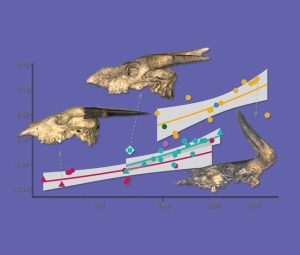
October 2026
Publication Comptes Rendus Palevol
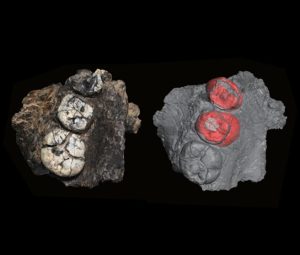
October 2026
Publication Comptes Rendus Palevol

March 8-10 2027
7th Virtual Conference for Women Archaeologists and Paleontologists

October 10-11 2026
Palevoprim invites you to l'Hôtel de ville, Poitiers