Publication Comptes Rendus Palevol

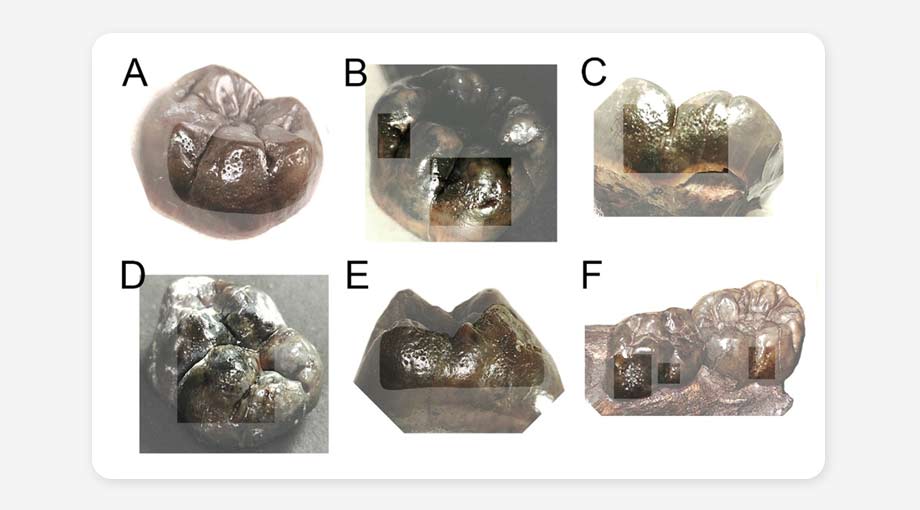
displaying uniform, circular, and shallow pitting,
using a microscopic camera
(Dino-Lite AF3113T).

References
Towle, I., O’Hara, M. C., Leece, A. B., Herries, A. I., Adjei, A., Guatelli-Steinberg, D., … & Hlusko, L. J. (2025). Uniform, circular, and shallow enamel pitting in hominins: Prevalence, morphological associations, and potential taxonomic significance. Journal of human evolution, 204, 103703.
hal-05461199DOI: 10.1016/j.jhevol.2025.103703
Uniform, Circular and Shallow (UCS) enamel pitting in hominins: Prevalence, morphological associations, and potential taxonomic significance Enamel pitting may offer novel phylogenetic insight for fossil hominins
This study explores a particular form of enamel pitting originally identified in Paranthropus robustus. We call this Uniform, Circular and Shallow (UCS) pitting to distinguish it from more irregular and non-uniform defects often associated with enamel hypoplasia.
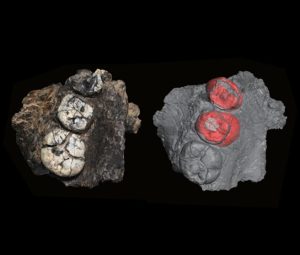
We pose the hypothesis that UCS pitting is unique to the genus Paranthropus. We test this by investigating hominin dental remains from the ca. 3.4 Ma to ca. 1.1 Ma fossiliferous sequence at Omo, Ethiopia (n = 76) to look for evidence of UCS pitting in an assemblage that includes at least three hominin genera (Australopithecus, Paranthropus, and Homo). We also examine the correlation between UCS pitting, tooth size, enamel thickness, and cusp proportions in samples from both eastern Africa (Omo) and southern Africa (Drimolen Main Quarry [DMQ] ~2.04-1.95 Ma, Swartkrans ~1.9-1.4 Ma and Kromdraai ~1.95-1.78 Ma). In the Omo specimens, we found UCS pitting similar to that seen in P. robustus. While we observed this pitting on five of 24 permanent teeth and two deciduous molars from both Paranthropus aethiopicus and P. boisei, we also identified UCS pitting on five of 13 non-Paranthropus hominin permanent posterior teeth from Member B (~3.0 Ma).
Our correlation studies yielded no association between the presence of UCS pitting and variation in tooth size, enamel thickness, or cusp proportions. The consistent appearance and characteristics of UCS pitting suggests a shared etiology.
Our findings also suggest that UCS pitting may result from a genetic effect related to enamel formation, potentially in association with specific environmental or dietary factors.
March 8-10 2027
7th Virtual Conference for Women Archaeologists and Paleontologists
October 10-11 2026
Palevoprim invites you to l'Hôtel de ville, Poitiers
October 2026
Publication Scientific Reports

September 29-30 2026
International workshop in Addis Ababa and official launch IRL PALÆTHIOPS

September 25 2026
Night of research in New Aquitaine, Poitiers