Midi Libre press article on the conference in Villeveyrac

References
Jaeger, J. J., Chaimanee, Y., Benammi, M., Marivaux, L., Chavasseau, O., Beard, K. C., … & Brunet, M. (2026). New late middle Eocene anthropoids from Dur At-Talah, Libya: Implications for early primate dispersal into Afro-Arabia. Journal of Human Evolution, 215, 103843.
DOI: 10.1016/j.jhevol.2026.103843
hal-05616856
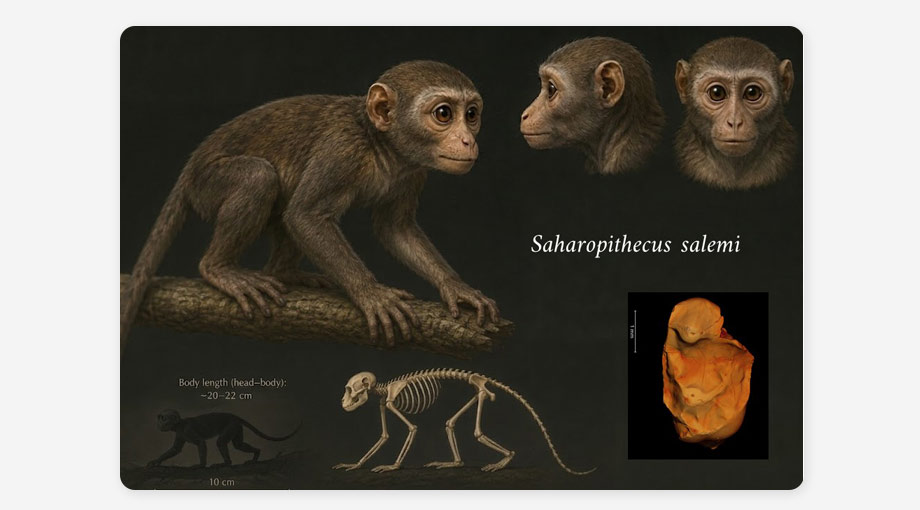
New late middle Eocene anthropoids from Dur At-Talah, Libya: Implications for early primate dispersal into Afro-Arabia
Eocene anthropoids from Afro-Arabia are central to understanding the early evolutionary history and paleobiogeography of higher primates. However, the timing and pattern of their initial dispersal into Africa remain debated. Fossil evidence from several northern African Eocene localities indicates an unexpectedly early diversification of anthropoids, giving rise to two alternative scenarios: a single dispersal of an Asian stem anthropoid followed by rapid in situ radiation or multiple independent dispersals of distinct Asian clades before the late middle Eocene.
The late middle Eocene (∼39–38 Ma) locality of Dur At-Talah, Libya, provides critical evidence for evaluating these hypotheses. Previously, three anthropoids were reported from the site: Biretia piveteaui (basal parapithecid), Talahpithecus parvus (early oligopithecid), and Afrotarsius libycus (stem eosimiiform). Here, we describe additional anthropoid materials that reveal greater taxonomic diversity than previously recognized. We establish a new taxon, Saharopithecus salemi gen. et sp. nov., a morphologically distinctive form of uncertain phylogenetic position that shares molar characters with both proteopithecids and propliopithecids. Additional specimens are referred to Talahpithecus sp. and Afrotarsius sp., increasing the documented anthropoid diversity at Dur At-Talah to at least four taxa.
These findings establish Dur At-Talah as the most taxonomically diverse Bartonian anthropoid locality currently known in Afro-Arabia and highlight the importance of continued paleontological exploration in the region for resolving early anthropoid biogeographic history.
Dans l’ensemble, ces deux spécimens présentent des similitudes avec le genre Homo, et plus particulièrement avec Homo erectus, en particulier dans l’épaisseur crânienne et la composition de l’os, ainsi que le type d’embranchement des réseaux méningés moyens pour OMO 342-10248a. Les ressemblances avec P 996-17a renforcent l’hypothèse de la présence d’hominines de type Homo erectus dans la basse Vallée de l’Omo il y a 1,15 Ma.
July 21-22 2026
2nd International Colloquium on Paleoanthropology in Chad
July 2026
Publication Palaeoworld
July 2026
PhD position Palevoprim & Wits University
July 6 2026 – 2 pm
CFEE seminar: The OGRE project
July 3 2026 – 2 pm
International seminar n° 83 Miksha Harripershad