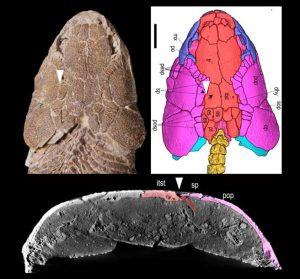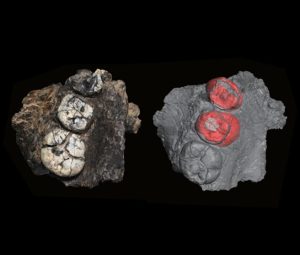
Fig. 3 - Bothriogenys vietnamensis skull
with left I3-M3 and right P2-M3
(ND-2014-03-22-2) from Na Duong

Références

Ducrocq, S., Chaimanee, Y., Chavasseau, O., Pha, P. D., Le Phuong, V., Suraprasit, K., & Jaeger, J. J. (2026). New specimens of anthracotheriids (Hippopotamoidea) from the upper Eocene of Vietnam. Palaeoworld, 201146.
DOI: 10.1016/j.palwor.2026.201146
hal-05670938

New specimens of anthracotheriids (Hippopotamoidea) from the upper Eocene of Vietnam

New anthracotheriid material collected from the coal deposit in Na Duong in northwestern Vietnam can be attributed to the three microbunodontine and bothriodontine taxa already known from there, with emendation of their diagnoses.

The dental morphology of these fossils also confirms the early late to middle late Eocene age proposed for the Vietnamese mammalian community. However, no new fossil material could be referred to the rare species of Elomeryx that was previously described from Na Duong.

The morphological resemblances between the Bothriogenys species from Na Duong and from the Fayum in North Africa reinforce the hypothesis of a Southeast Asian origination of the late Eocene North African anthracothere fauna.

However, the similar dental affinities of the Na Duong microbunodontine and those from China suggest that geographical barriers were probably an obstacle to some faunal exchanges between northwestern Vietnam and more western regions like Thailand (Krabi) and Myanmar (Pondaung) during part of the late Eocene.

18 juillet 2026

Article de presse Midi Libre sur la conférence à Villeveyrac

Juillet 2026

Offre de thèse Palevoprim & Université de Wits

Retour en haut