Publication American Journal of Biological Anthropology

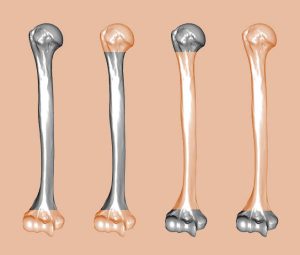
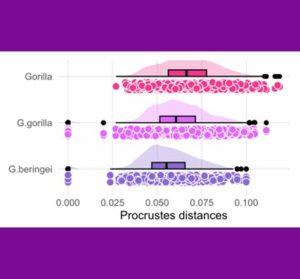
size in the humerus of extant great apes.
Références
Aramendi, J. (2026). Functional constraints mask species-level signals in hominid limbs: Long bone morphology and the challenge of taxonomic identification. Journal of Human Evolution, 218, 103873.
10.1016/j.jhevol.2026.103873
Functional constraints mask species-level signals in hominid limbs: Long bone morphology and the challenge of taxonomic identification
Species boundaries are central to evolutionary biology, yet the reliability of skeletal morphology, particularly isolated postcranial elements, for diagnosing species remains unresolved.
Long bones are commonly recovered in the fossil record and often used as operational taxonomic units but are shaped by functional and developmental constraints that may decouple morphological differentiation from species diagnosability. Here, morphological variation in the humerus and femur is examined across extant great apes to assess their utility for species delimitation, with implications for extinct hominins. At the genus level, differences between groups are expressed through significant differences in morphology and commonly in disparity. Among species-level taxa, mean shape differences were consistently detected, although without corresponding differences in disparity, indicating morphological differentiation within a constrained envelope.
The results further indicate that the femur may be more informative than the humerus for detecting taxonomic and functional signals among hominids and that data availability can influence results obscuring morphological differences, as demonstrated by simulations on fragmentary bones and analyses of landmark taxonomic signals.
Overall, these findings show that although postcranial long bones can track morphological changes and retain valuable taxonomic signals, they remain weak proxies for species boundaries when studied in isolation, with direct implications for taxonomic identification in the hominin fossil record.
Août 2026
Publication Journal of Human Evolution
18 juillet 2026
Article de presse Midi Libre sur la conférence à Villeveyrac
21-22 Juillet 2026
2ème Colloque de paléoanthropologie au Tchad
Juillet 2026
Publication Palaeoworld
Juillet 2026
Offre de thèse Palevoprim & Université de Wits