Midi Libre press article on the conference in Villeveyrac

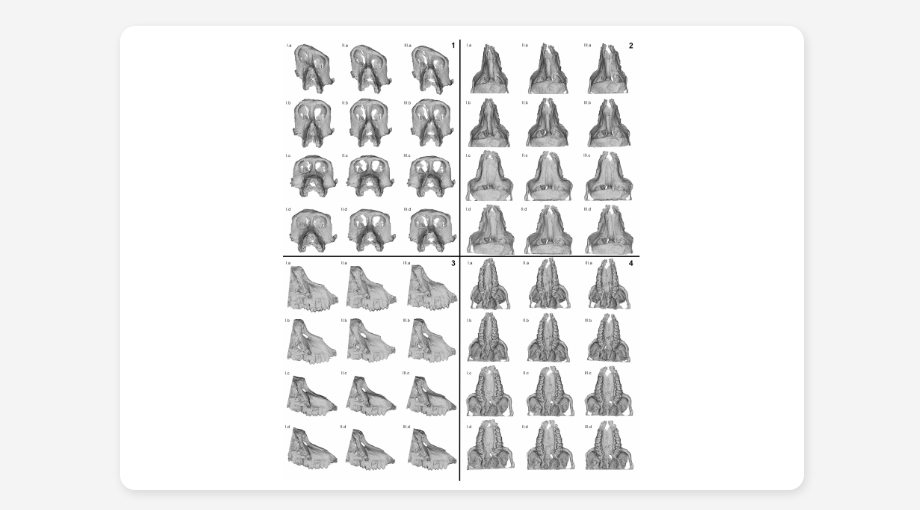
DFN3-150 and subsequent reconstructions.
Références
Koutalis, S., Röding, C., Merceron, G., Guy, F., Kostopoulos, D. S., & Harvati, K. (2026). Virtual reconstruction and analysis of the face of DFN3-150 Paradolichopithecus aff. arvernensis specimen from Dafnero, Greece. Scientific Reports, 16(1), 14703. https://doi.org/10.1038/s41598-026-51595-8
Virtual reconstruction and analysis of the face of DFN3-150 Paradolichopithecus aff. arvernensis specimen from Dafnero, Greece
The systematics of the Eurasian Late Pliocene – Early Pleistocene monkey Paradolichopithecus is a long-debated topic in primate paleontology. This taxon’s phylogenetic position has implications for our understanding of cercopithecid evolution: while it is often regarded as a baboon-like Macacina, an alternative taxonomic attribution to the Papionina subtribe has been proposed.
This would challenge the commonly accepted hypothesis that baboons constitute an endemic African clade. Here, we reconstructed the face of the subadult female DFN3-150 Paradolichopithecus aff. arvernensis cranium from the Lower Pleistocene site Dafnero (Greece), using novel virtual techniques and following alternative protocols. We performed a geometric morphometrics investigation of its morphological affinities with two extant papionin genera. Our results allow for a critical evaluation of the two applied retrodeformation protocols and support stronger facial morphological similarities with Papio spp. than macaques.
This is in agreement with recent studies evaluating its phenotypic and ecological traits.
Nevertheless, direct inferences on phylogenetic affinities require a larger and more diverse papionin sample.
July 21-22 2026
2nd International Colloquium on Paleoanthropology in Chad
July 2026
Publication Palaeoworld
July 2026
PhD position Palevoprim & Wits University
July 6 2026 – 2 pm
CFEE seminar: The OGRE project
July 3 2026 – 2 pm
International seminar n° 83 Miksha Harripershad